
Stevie Wonder, Undertaker
A brief list of funerals where he's performed, on the singer's seventy-sixth birthday

I’ve had some good days, I’ve had some hills to climb, his homegoing service repertoire begins… by four minutes in the mourners are standing, jumping, fanning their palms like dove’s wings and he’s onto the ululating I said thank you lord, I said thank you lord, I won’t complain… The I wobbles and tilts like a plain gait turning into a trot, and he taps the mic like it’s a fuzzy drum if he’s not seated at the piano or keyboard. He bids his friend adieu triumphantly. He’s a trolly arriving to usher them to their next destination; he does it with grace and a touch of the mechanics of a professional. Beneath the cloak of his ready-gospel, you forget someone died, you forget death is sad and terrifying, you stop feeling abandoned and begin to welcome the new ancestor into covenant with the others, to say goodbye and mean it. Stevie delivers God’s final word on the matter. When does he get to cry and be cradled by a solacing voice saying everything is ok now and forever, no matter where? There could be a double album comprised only of Stevie Wonder’s performances at the funerals of black musicians and politicians, his friends, colleagues, often younger than him in years if not in spirit. I wonder what the toll is on his spirit, none it seems, other than augmented divinity. And he’s quieter lately. Lately, I’ve had the strangest feeling, he sings. Lately is an indulgent word, announcing precognition pretending to be a present-moment’s insight. What follows it has always already happened. That strange feeling, a promise breaking, a bell ringing too late at night or a sprinkler system mimicking fireworks or a band of snakes, a warning. But some people cannot be haunted, only harnessed as healers of that part of you that would try to inflict angels with the lore of ghosts. He is among them. He leads us by example toward this exemption. His sound cures black celebrity death of all stagnant morbidity and some of the cloying sentimentality too, of the tabloids and biopics and opportunistic news cycles. Our hero of the black funeral concert, our beacon against the shadow. Brought my darkness into day, chased all of my tears away… I won’t complain.
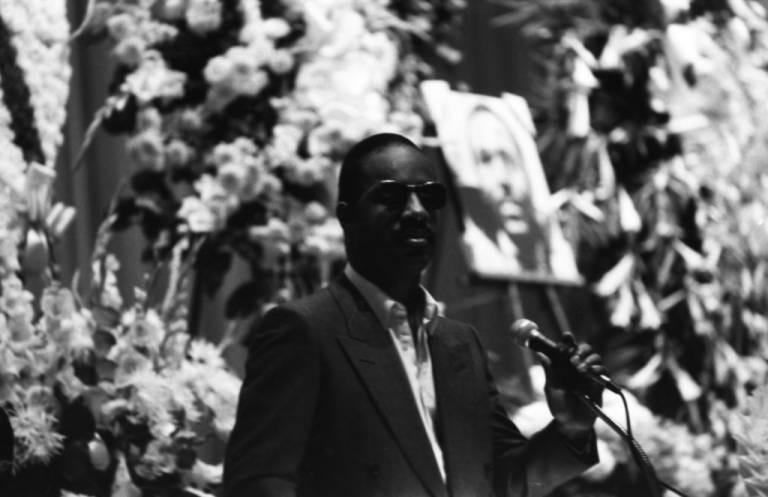
As far as an incomplete list goes, there was Marvin Gaye (1984), James Cleveland (1991), Ray Charles (2004), Luther Vandross (2005), Michael Jackson (2009), Etta James (2012), Whitney Houston (2012), Aretha Franklin (2019), Nipsey Hussle (2019), Roberta Flack (2025), D’Angelo (2025), Jesse Jackson (2026).
There is a skill to crafting occasional works. As such, I enjoyed teaching occasional poetry to my creative writing classes. And, for a few years, I was the "go-to" poet to read whenever a local activist or artist had transitioned. It was, for lack of a better term, an artistic responsibility that I embraced with honor. (Here is the link to me reading at the homegoing celebration of Jackson, Mississippi, Mayor Chokwe Lumumba: https://www.youtube.com/watch?v=CS2QmFMhay8.) Then, one day, I was at an event (not a funeral), and a city councilman approached me and said, "Man, it's so good to see you when no one is dead." In my head, I was like, "WTF! Is that who I am? The funeral poet?" That being said, while funerals for public figures can be more "show" than an honest mourning or celebration of life, the artists who use their gifts to comfort and encourage the family and community are performing a public service. And, I can only hope that younger artists are being taught to understand this.
Keep in mind that most of those people were good friends of his...