
Seance or,
Three calls to prayer on the end of the year: Justin Bieber, Timothée Chalamet, D'Angelo

God help the child
A tongue slipping in the middle of rehearsal for god bless the child, bliss gone to hell and back, turned moon pale and inside-black.
These white kids of industry and industrialized allure, emaciated by nature and gorgeous for it in the dilapidated Hollywood, show me the way-way, love the dark gospel of their missing black notes. One sings and the other sways. One stiffens so the other surrenders. They are distant lovers, ardent admirers but not quite groupies and never minions; they love the music of the culture beneath them, bracing them, they love the sounds their hegemony produces, their love is criminal and absolving. They belong to a members only gentleman’s club made up of those who are praised for blunt mimicry of black habits and tastes, Elvis’s sons, but better because they ‘hold space’ (the therapized but never quite healed of anything but accountability generations love this phrase), for their black colleagues and know what they are extracting, they seem honored by the pass or invitation, depending, and not purely entitled, this is their affect at least. Their leisure is black.
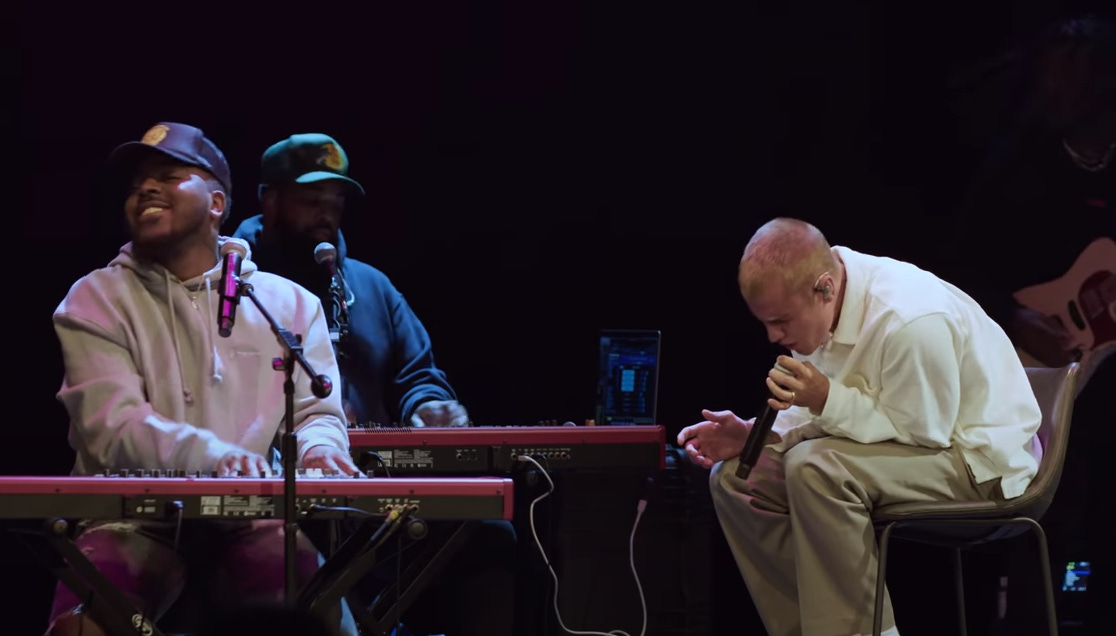
During the final weeks of the year of the snake, Justin Bieber and Timothée Chalamet have reiterated their unrestricted access to blackness with spontaneous praise songs performed publicly on livestreams. The white minstrels are rebooting, it’s going to be a good time, a commiserating, co-mingling, doing just-fine-time in American music. We’re restless about the same stagnation and together we can divert one another’s attentions to how pleasing a sound mirror we make for one another. Justin, being a singer, was the more impressive of the two. With an IV stuck in his arm and the backing of a black keyboardist and guitarist while on drums himself, he testified, covering a James Clevland lyric, God has been so good to me, he’s been so good to me… god has his hand on me, I don’t gotta be alone, I don’t gotta be afraid, I can wake up every morning, and walk with you each day.
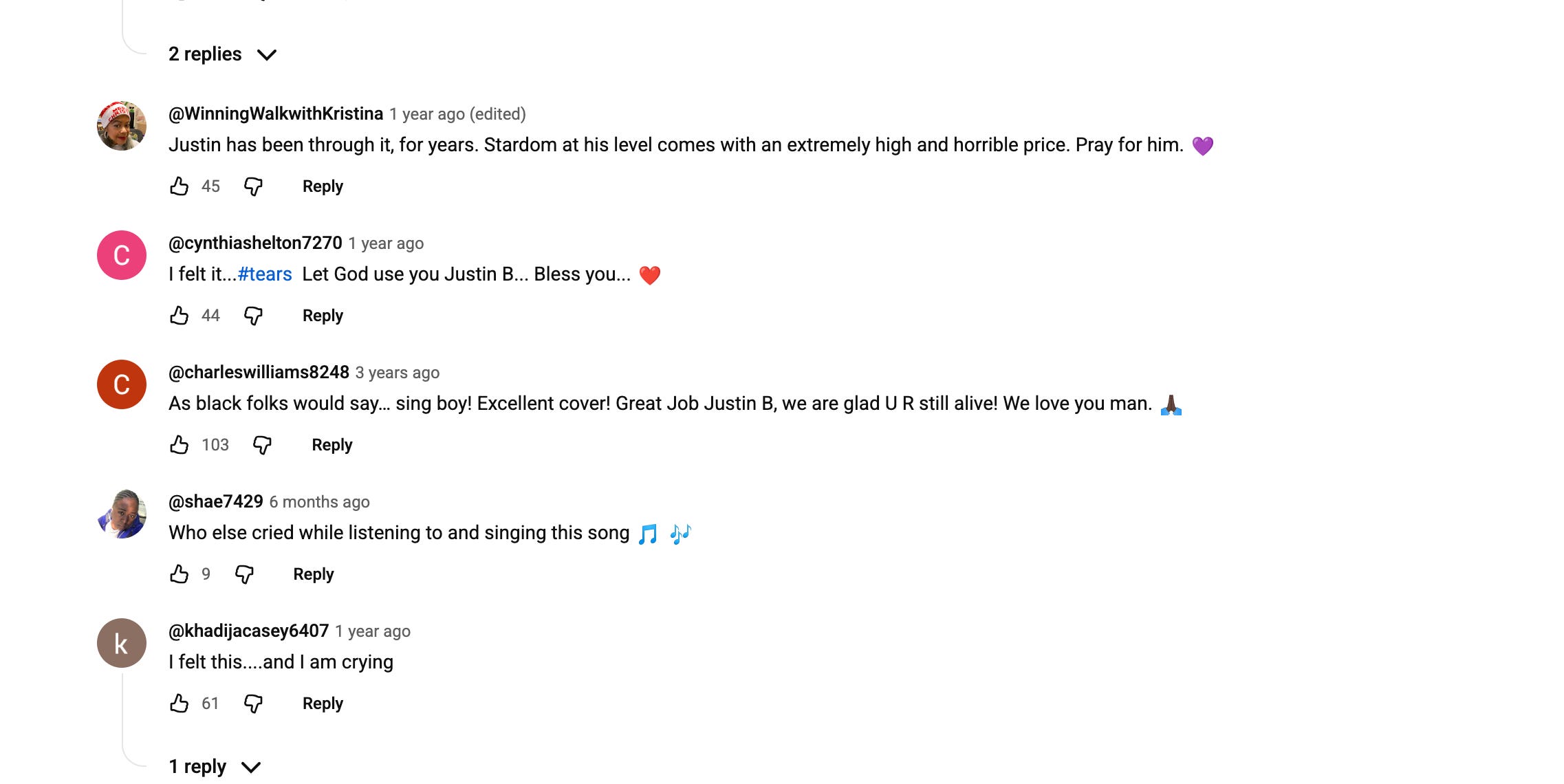
In some segments of this rendition of the 1974 song, he sounded like Ben Harper meets Richie Havens pleading at Red Rocks, a displaced member of the hippie generation in his regenerative call for peace on earth and angels sing, in others Bieber’s trembling, razor-thin falsetto begged Eddie Kendricks and Sam Cooke back to this realm. Overwhelmingly, he sounded like a child kneeling before his bed at night, a boy who vividly remembers his past life seeing ghosts in the dark and becoming a prayer warrior to ward them off of his living name. A consoling black hand adorned in gold massages his shoulder in the thirteenth minute of this nineteen minute solo for group dancers (a perfect EP cover), and he shifts to the interrogative. Why is it so hard to love, he asks, conflating the romantic and spiritual though at best they are one, at best differentiation is petty, at best the boy grows up and forgets past torment and becomes a miracle, a husband, a father, a man of God. By the end of the session, he’s on the floor, leaning on the elbow with the concierge IV in it, mic in the other hand, calling on Jesus. Despite this, his alienation has a secular, existential texture; it seems both dire and like he’ll snap out of it once his electrolytes are balanced, go to a party, nightclub or all night studio session, and then return to this public sanctuary to repent again by dawn. If it’s possible for humility to be aggressive, his is, though no less sincere for it. Justin is Christianity’s and Hollywood’s perfect sinner/saint hybrid. A singer, not a movie star, therefore less compromised. A singer doesn’t need to wait for a script in the same way a real actor does, he can fall on his knees whenever the mood strikes and sell albums while authentically crying out for mercy. No one will ask if there’s a perpetrator puppeting his cries, some groomer or agent of his indentured service to entertainment can get by in the shadows while he struggles and sells streams (hear dreams). This church/home movie/live stream earns him his nom de guerre from the black community: Jaquavius Bieber. His neck is jerking like he’s whip testing a ‘90s Wu-Tang album as the camera fades out.
Tension, not bad rhythm, is what yanked his neck forward ahead of the song’s tempo. Timothée, on a different stream, with famed black comedian, industry plant, TikTok star, Druski, begins singing Kirk Franklin unprovoked and creates a frenzied, jubilant duet that echoes throughout the etheric realm for weeks. Something about the name Jesus/It’s the sweetest name/Oh how I love the name Jesus/Oh how I love the name Jesus. When Druski asks whatchu know about that, boy, Timothée doesn’t answer, he just keeps singing in tempo (a quiet insolence in his persistence). He’s also just released mediocre rap music that sounds like someone with a nice enough vocal tone talking really fast. With no flow but decent oratory he gives us decentralized self-aggrandizing rants set to beats, the cadence of a human metronome trying to slant. It’s fine. I have this calm indifference to appropriation or approximations of it these days, it makes me hopeful or even certain that we’re about to leap into something that will be impossible to mimic for decades or at least a few glorious months or years. Observing these bastard gospels. I don’t gasp or even bemoan anyone; the temptation to be more like the best things you’ve encountered is understandable, who would either of these subjects be without black culture? It’s fine that some pamper them and fawn as they borrow it for sanctification, swagger, and comfort, it’s so dilute in them, so inoffensive, so repackaged into aphorisms for your convenience.
Another posthumous D’Angelo leak intervenes and implicates everything. I’ll never stop deferring to him. This time it’s from the Voodooo sessions and called “We Gotta Run and Pray Together.” A breach of his privacy in the service of our sinsick souls, it’s the third gospel on the end of this year. The title loops as hook over and over for three minutes, it’s the shell of a song, a glimmer, a flickering light of enchanted admonition. Is running and praying shorthand for instructions that cannot be delivered on the record for fear they might drift into the marketplace and reveal our plans for ambush. Earlier this year I learned, in a poem by Saul Williams, that once upon a time, people could rent slaves from the New York Stock Exchange, which was formerly The New York Slave Market. I think of Druski and the unnamed pianist and bass player in Justin’s blood pleading session. Maybe it matters, how and with whom we run and pray, but as ghosts for rent we cannot safely gate-keep ourselves, we have to share gospels with benevolent overseers, withholding would be betrayal of the very God we’re all invoking and violating and calling forth again, is one way to regard it. Another is with Billie Holiday’s cautious, wry punchline as prayer, God bless the child that got her own. Why worry about their borrowed time. Living on borrowed time the clock ticks faster, as MF DOOM reminds us on “Accordion,” before the speaker meets his maker. Don’t be so paranoid about the inevitable, don’t be so borrowed, you’re born to slow horses.
And God Help The Child is Toni Morrison’s final published novel, containing reverberations of Billie Holiday and all of us in reluctant supplication. It’s about a lightskinned black woman who gives birth to a darker child and everyone suffers and becomes neurotic and evil about it, at least that’s the premise. Once upon a time, Toni, (born Chloe, who took the name Toni after the catholic saint Anthony she was baptized under, because no one could pronounce her real name correctly), compared Bill Clinton to a black man during his impeachment scandal, citing class (his impoverished upbringing), the saxophone, and his love of McDonalds as evidence he was trapped in a false skin. I don’t blame her, I think she was trying to run and pray together the best way she knew how then. We are servants of liberalism even when we disavow its system of representation and inherent essentialisms; we need them now and then to invent myths that lighten the doomed mood at our expense. The article appeared in the New Yorker. As long as we’re all so preoccupied with one another’s gifts and curses across these arbitrarily shifting lines, the West, this Hollywood empire, and its endless revisionist histories that accost us like movie scenes, will never fall. And there is something about the name Jesus, distant descendant of Zeus on the tongue, a decadent vamping toward the crossroads where everything and nothing is forgiven. It’s worth recording the unabashed ways they turn to black music again and again, when they need to get nearer to that something, that sweet thing, that nearer to god that thee feeling, the world’s most lethal infatuation, mutually catastrophic, brood of my blood, may it never be diminished by becoming real love.
Below an excerpt about prayer meetings, Mingus, radical hospitality, and excess.