
Keith LaMar/Cypress Hill
The year's most important jazz album and a hip hop track from 1991

You’ll own nothing and be happy
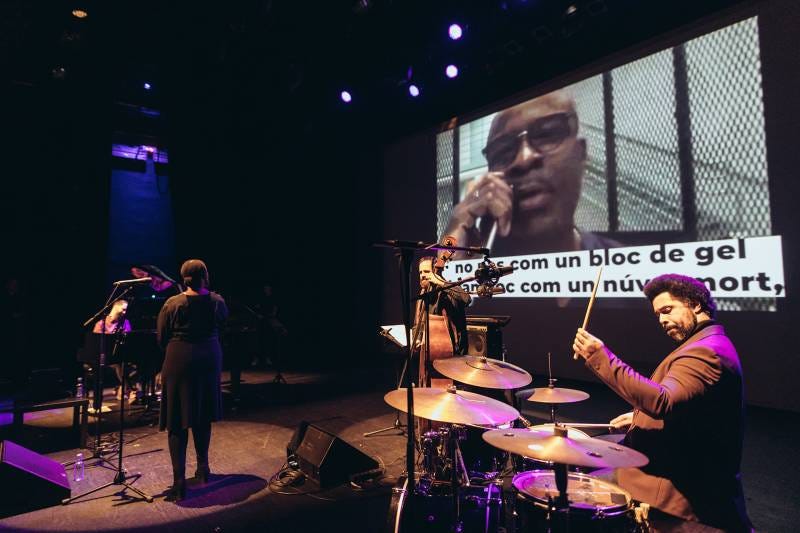
Whether or not I am successful at stopping these people from killing me, you are now listening to my last will and testament, Keith LaMar announces. He’s called in from Southern Ohio Correctional Facility where he’s being held in solitary confinement on death row while awaiting an execution by lethal injection now scheduled for January of 2027. He’s been in solitary confinement for thirty years; first sentenced to eighteen years for an unintentional killing during a drug-related shooting gone wrong, and later falsely accused of killing fellow inmates during a prison riot and given the death penalty. A fellow inmate, an elder named Snoop, introduced LaMar to jazz early in his sentence and music has been his solvent ever since. When he discusses his love of jazz, I wonder if he is freer in spirit than many of us. I wonder if I’ve been hearing with mercenary ears and needed his capacious awe as reminder to reunite with my own enthusiasm as a listener.
And I realize I didn’t know prisoners were allowed to listen to music, especially those on death row and in solitary confinement. I think of Baraka, who describes whistling John Coltrane’s music in solitary confinement in 1967, before the guard slips him Coltrane’s obituary with the ink still damp. I can’t decide if I would buckle at the torso and weep against a cold wall if confronted that way, or whistle louder. I google: How do inmates access music, and find an article about the tablets many are given with access to streaming and albums that can be purchased with money from commissary, and then I think of surveillance and frequency wars, the CIA’s well documented Gateway Program, and Palantir— and whistle louder, spread my ribs like proud vestigial wings how I learned in dance classes, to ensure my heart posture is in tact, and play Monk’s “Brilliant Corners” before returning to LaMar’s recording.
My mind stayed on freedom
The album is recorded live, hence the title, which might end up conflated in the mind with Death Row Records and the travesties of industry but this is no label name or brand of scandals. The first track is a gospel recorded in operatics until it feels gothic and almost mocking in its beauty, repeating, woke up this morning with my mind stayed on freedom until interrupted by an AI voice hello, this is a prepaid debit call from (a pause, then Keith’s voice, he states his name in a grade school roll call tone) an inmate at the Ohio State Penitentiary, to accept this call press zero. You hear the button touched and then the drone voice warns that the call is subject to monitoring and recording. We need a word for when a warning or threat is also an unequivocal promise, as this is. LaMar’s collaborator, Barcelona born, New York based pianist, composer, and public school teacher Albert Marques asks a tentative can you hear me, and they begin. We’re here to share the beauty of what it means to be part of a movement, Keith introduces himself to the cheering Brooklyn crowd, and he enters a sermon about the miracle of radio and liberation theology, dragging the vowels and emphasizing the suffixes like a civil rights era orator with street edge. Covers of Coltrane’s “Alabama,” “Acknowledgement,” and Transformation, and of Billie Holiday’s “Strange Fruit” commingle with original poems and oral histories read over the music.
The most poignant among them is the most dissociated from campaigning or education, a meditation “On Living” that repeats the refrain, living is no laughing matter. You must take life so seriously that even at seventy you plant olive trees, he contends, after a subtle description of a strip-search. He is telling us and whatever surveillance agents are on the line listening, that he cannot be dehumanized or silenced, that their days are more spiritually mediocre than his, that they have emancipated him in effort to martyr him, that he now embodies the harrowing clichés of all survivors of tribulation who, when chastised beyond what many can conceive, become heroes and overmen. I love those who go under; for they are the ones who get over. It’s in his intro to singer Nia Drummond’s interpretation of “Strange Fruit” that you can best make out the muffle or muzzle or brisk, chafing,, cage the phone places around his voice, a like a film of digital phlegm which, when he speaks through it, becomes crackle and growl fighting soft enraged tears, twenty-first century death row inmate calling in from a tablet alone in his cell tears, unshed. By the final track, “Truth,” the ghost in the machine begins warning us that our time is almost up. The song itself is upbeat bordering on jovial, reminiscing about a first love real or imagined, named Liberty. His rhymes no longer slant, they stomp or clap before it all slips into rhetoric about how no one is coming to save us, and this is our one only chance to do something righteous with our life— the monster intercedes as if to tease you thought, a clipped thank you for using GTL, and then a sudden dial tone and the band keeps playing, no longer live from death row. Beyond formalized ranking, this is the most important jazz album released this year because what does it mean to record live from a prison and read poetry to strange yet gracious spectators over the the freest musical idiom we have before the machine shreds you back into oblivion and jumpsuits? Did you know inmates had access to music? And how have you been using your access to it?
Fool’s Errand
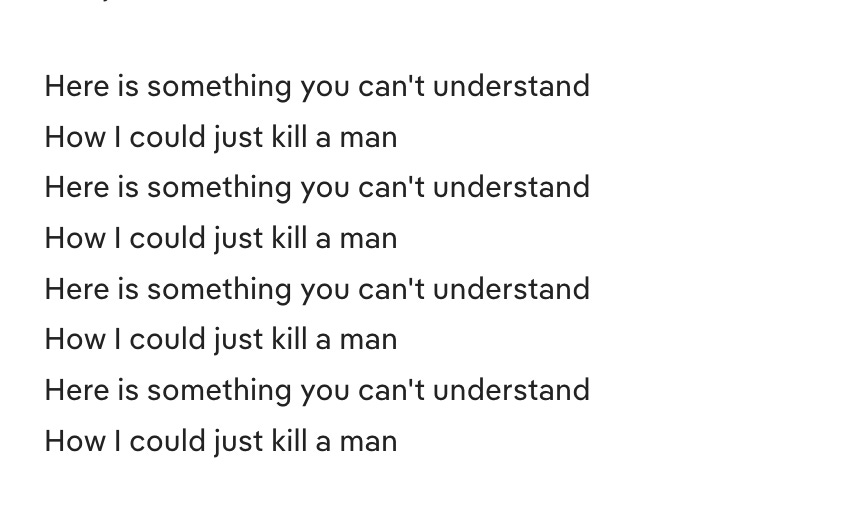
Cypress Hill’s 1991 chant-come-song “How I could Just Kill a Man,” is the next track I listen to on purpose, as if I’ve been over-soothed by virtue. The rap group muses about homicide on that threat-promise-what-if axis that makes evil miracles seem easier to recover from than all the good will in the world. It’s a simple song that refuses to admit guilt or remorse but implies having reached the limits of peace and snapping. The tone of the chorus is that of one who gave up on decorum and became intentionally reckless, ballistic, for fun, and has gone on a crime spree as if hoping to feel closer to the comfort of death by inflicting it:
There are so many violent revenge fantasies in music, rehabilitation seems boring from the outside, like a form for failing or forfeit. Brought inside by Keith LaMar, to where snapping would turn the tenuous tremolo on the phone line flat as stacked corpses, rage seems less cathartic, more like a trap, another life sentence. And those who would play God in the life of an innocent man and attempt to decide his fate as a means of expiating theirs are so foolish it’s almost romantic to watch them lose themselves in him.
—
(I am going to try to book Keith LaMar for a show in LA in the coming year. )
(Below is Amiri Baraka’s writing on Thornton Dial and the importance of self-teaching in art)